
CARA Medical · Clinical decision support
Guiding clinicians through life-critical cardiac decisions.
A clinical platform redesigned around operating-room pressure, with role-separated workflows, faster annotation, and a dark interface where every action has consequence.
Duration
2025–2026
Duration
2025–2026
Duration
2025–2026
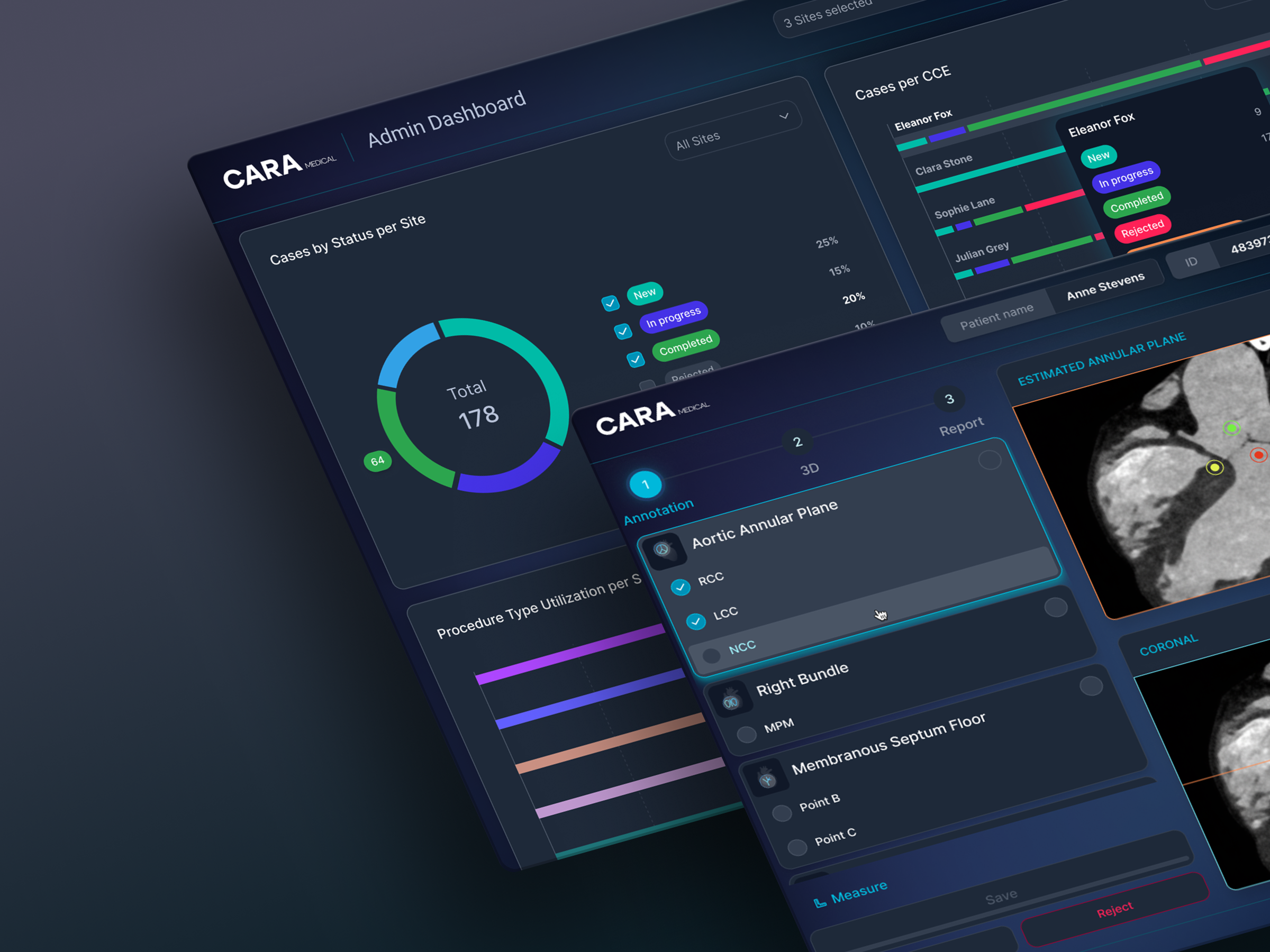
The challenge
The software had to disappear behind the clinical decision.
Clinical teams needed to inspect anatomy, annotate findings, and prepare procedural decisions inside a high-stakes TAVR workflow. Existing tools buried the important work inside generic viewer controls and unclear task paths.
The design problem was not simply making a dense interface cleaner. It was deciding what each role needed to see, which actions could wait, and how to make the next critical step obvious under pressure.
01
Separate roles
Coordinators, clinicians, and procedural reviewers enter through distinct working contexts.
01
Separate roles
Coordinators, clinicians, and procedural reviewers enter through distinct working contexts.
01
Separate roles
Coordinators, clinicians, and procedural reviewers enter through distinct working contexts.
Workflow design
A clear path from patient selection to procedural review.
The redesigned workflow begins with a focused patient list and makes procedure status visible without opening each record. Once a case starts, the system progressively reveals the tools required for annotation, 3D inspection, and reporting.
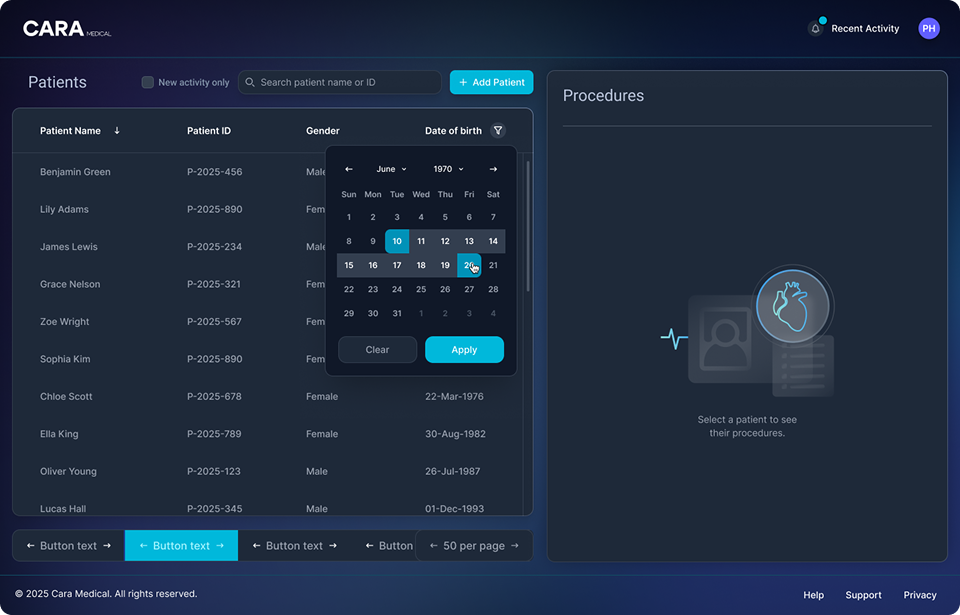
Patient workspace
Search, filter, and procedure context share one clear entry point.
Annotation workspace
Turn a specialist task into a guided sequence.
The annotation workspace keeps anatomy, progress, and imaging context visible together. The left rail communicates what is complete and what still needs attention, while the main canvas preserves the image detail required for confident decisions.
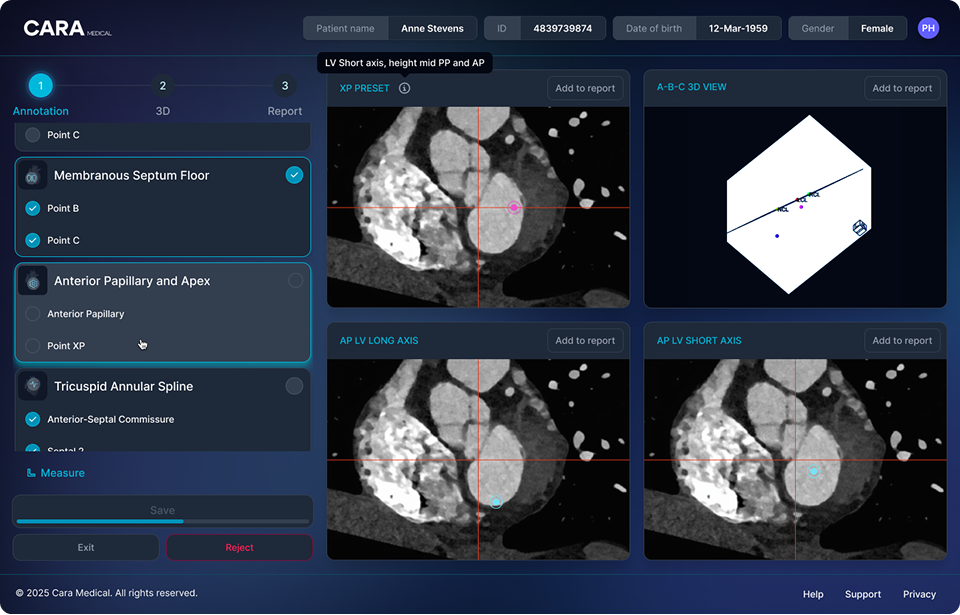
Guided annotation
The next action remains visible without obscuring the imaging workspace.
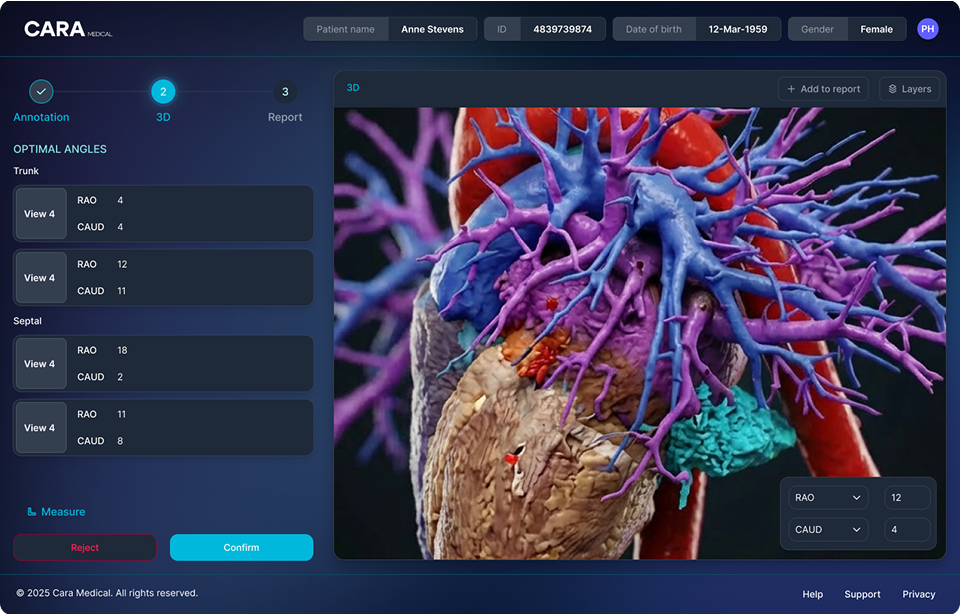
3D review
Spatial context for procedural planning.
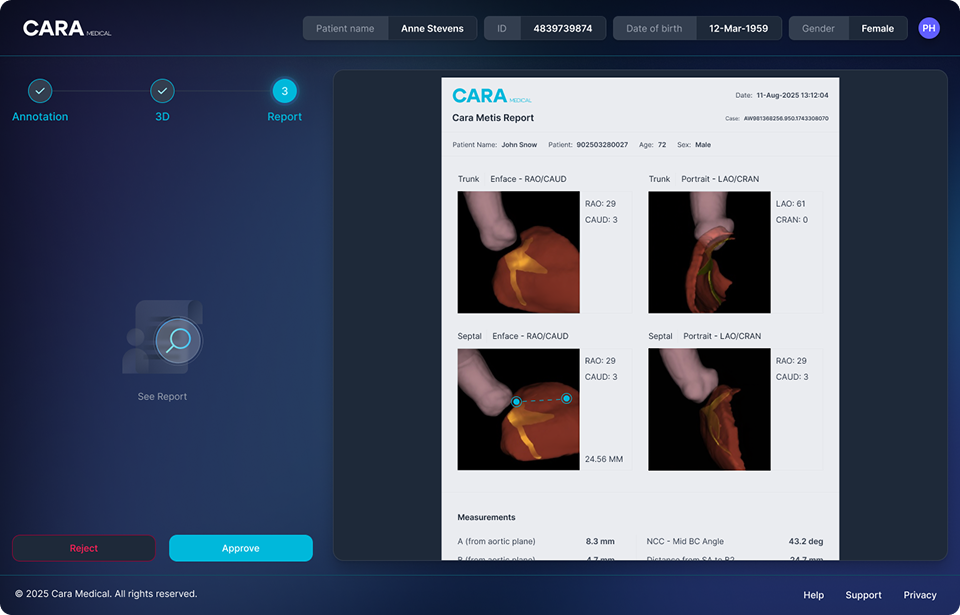
Clinical report
Findings structured for review and handoff.
Let’s work together
Back to home page
CARA Medical · Clinical decision support
Guiding clinicians through life-critical cardiac decisions.
A clinical platform redesigned around operating-room pressure, with role-separated workflows, faster annotation, and a dark interface where every action has consequence.
Role
Product design · Research · Design system
Duration
2025–2026
Focus
Clinical workflow · 3D imaging · Enterprise UX
The challenge
The software had to disappear behind the clinical decision.
Clinical teams needed to inspect anatomy, annotate findings, and prepare procedural decisions inside a high-stakes TAVR workflow. Existing tools buried the important work inside generic viewer controls and unclear task paths.
The design problem was not simply making a dense interface cleaner. It was deciding what each role needed to see, which actions could wait, and how to make the next critical step obvious under pressure.
01
Separate roles
Coordinators, clinicians, and procedural reviewers enter through distinct working contexts.
02
Guide annotation
A constrained sequence replaces a blank canvas and reduces unnecessary decisions.
03
Protect attention
Color, density, and action states are reserved for information with clinical consequence.
01
Separate roles
Coordinators, clinicians, and procedural reviewers enter through distinct working contexts.
Workflow design
A clear path from patient selection to procedural review.
The redesigned workflow begins with a focused patient list and makes procedure status visible without opening each record. Once a case starts, the system progressively reveals the tools required for annotation, 3D inspection, and reporting.
Patient workspace
Search, filter, and procedure context share one clear entry point.
Annotation workspace
Turn a specialist task into a guided sequence.
The annotation workspace keeps anatomy, progress, and imaging context visible together. The left rail communicates what is complete and what still needs attention, while the main canvas preserves the image detail required for confident decisions.
Guided annotation
The next action remains visible without obscuring the imaging workspace.
3D review
Spatial context for procedural planning.
Clinical report
Findings structured for review and handoff.
Fewer actions to complete the core annotation task.
The final direction reframed the product around usability under clinical pressure: fewer actions, clearer ownership, and a viewer designed around the decision rather than the software.
Let’s work together